Manipulation of fractals by boolean operations
Attention: The videos contain partially iridescent
image sequences, which are unsuitable for photosensitive people and in extreme
cases can lead to an epileptic seizure or eye migraine.
Jul. 2020 (last update July 2026
Video
The video starts after selecting a preview image using the "Youtube" button with a lower image resolution or using the "opartandmore" button via a video server with a higher image resolution. When using YouTube, however, evaluations are carried out by YouTube (see Imprint).
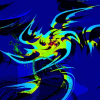
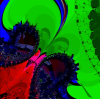
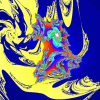
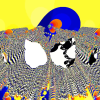
This page contains the representation of fractals, in
which the pixels of the individual video images are formed by a logical linkage
with the pixels of the preceding image. This results in a separate optical time
series for each pixel, which is influenced by the logical linkage as well as by
the respective image section and the respective calculation of the fractal. So
that a pixel does not change into an unchangeable extreme value (e.g. black or
white) by the iterative logical connection, extreme values are cyclically reset
to a starting value, similarly as with a modulo operation with natural numbers.
The chosen optical iterations
lead to the fact that in the overall context of the pixels apparent vistas or apparent
three-dimensional formations or also iridescent surfaces or points arise. The actual fractal then remains only partially visible.
The following Boolean functions
were used as logical operators in the iteration of the pixels for each of the videos:
fBOOL: AND / XOR / OR NOT / MAX / OR / AND NOT

Here
the following iterations were performed:
a) for the calculation of the fractals:
f
k+1 := f (o) fk
with 50 iterations (k) at each pixel per video frame; (o) corresponds to one iteration step
f: see above in the caption of each video;
c: variable in time as c(t) with an expiration of the time axis t := t+1 per video frame; c is here a given sequence of complex numbers by which the visible structures of the fractal f can be changed dynamically.
The calculated fractal value fk is then converted to the RGB color model using a custom
color model with a color depth of only 780 color steps at most.
b) subsequently for further iterative color
processing of the pixel colors RGB:
RGBi+1 :=
fBOOL
( RGBi , RGB(fk+1)
)
with a sequence (i) of 25 frames per second at each pixel. RGB(fk) represents the value of the color corresponding to the original color value of the original fractal after the final k-th iteration;
The flow of the time axis t is harmonized with the iteration i in the circuit, i.e. t == i and corresponds to a clock pulse.
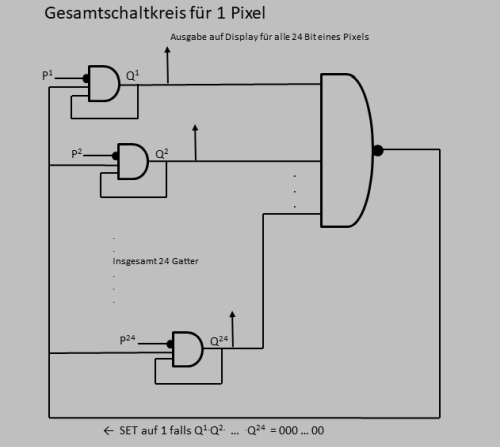
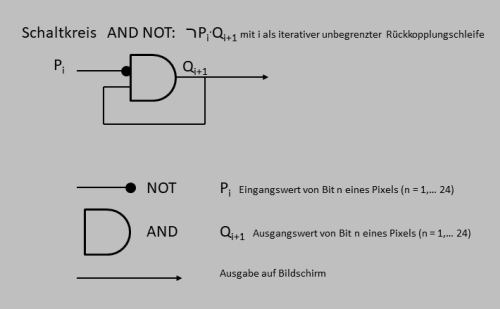
The Boolean functions were repeatedly applied individually for all 24 bits Pn (n:=1,..24) of each pixel and linked with the respective current bit Pni of the RGB color value (RGBi) of the fractal. Subsequently, the newly determined bits (Qni+1) were displayed on the screen as the new RGB color value RGBi+1.
Since some Boolean operations in the iteration process end at white (all 24 bits Qn == "1")
or black (all 24 bits Qn == "0"), a SET or RESET of the circuit (here in the example with a logical
NAND) was performed for all 24 bits in each case for such events.
The circuit for a complete pixel with the AND NOT function has therefore the following structure:
At a screen resolution of 500x500 pixels, 250,000 circuits of this type are thus
emulated 25 times per second for each individually calculated fractal image, whereby a sequence of 25
new fractal images with 50 iterations each was previously calculated per second as an input variable for
the circuits. The original fractal value calculated after 50 iterations for each pixel position is converted
into an RGB value, which is then processed by the circuitry before finally being output to the display.
The circuits correspond to an
artificial neural network that is single-layered and has a
recurrent form with a direct feedback loop.
Through
changing the coordinate window (enlargements and reductions), and
the navigation in the fractal as well as through changes of the term c in the fractal functions
jumps or movements of partial images and also apparent three-dimensional movements or
apparent transparency of partial images in the course of the
of the video become visible
during the
video calculation with the circuit incl. the automated
removal of extreme pixel values (SET and RESET). All this results in the artistic representation
of this kind of calculations. Some of the Boolean operations (e.g. XOR)
lead to rather unpleasant iridescent optical impressions.
For the sake of completeness, however, some videos are presented here anyway.
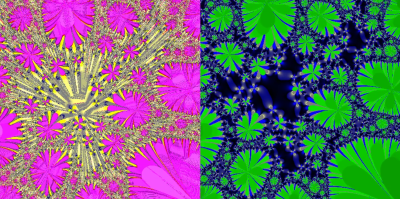
A comparison between a
conventional representation and the representation alienated by the circuit
is shown in the following video as an example. Colors
colors appear inverse (negation of the input colors in the circuit) and
background colors are partially preserved due to the iterative feedback
whereby new background structures can become visible:
Left Image output via circuit; right image original representation:
Experiments with Network II using different Boolean functions for alternative types of neuronal connections have not yet been conducted.
Video starts by clicking on an image
Corona Mutant
:
(z5+c)/z3
Boolean operation by NOT AND
(0:53 min)
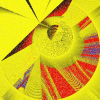
The external view symbolically represents the coronavirus. After significant zooming into the internal views, the perspective returns to the exterior. In the process, the artificial neural network generates yellow, spiky, rapidly growing protrusions that appear unexpectedly aggressive, as the network attempts to take over the entire video frame. Only by rapidly pulling back from the interior via manual control is the neural network prevented from allowing the yellow areas to dominate. In subsequent attempts, it was not possible to replicate this exact configuration involving the neural network's breakout. This breakout symbolizes the progression of the pandemic over time.
Swirl
: z2-cz
Boolean operation by AND
(0:55 min)
The initial input figure is set in motion and rotation via manual control through various scaling and translation commands. In the process, the neural network transforms the overhead view into three-dimensional-looking perspectives that can no longer be controlled manually. Finally, the neural network outputs the result of its analysis.
Coloured Roses
:
(z3+c)/z
Boolean operation by AND
(1:11 min)
The input figure is set in motion and rotation via manual controls, using various scaling and translation commands. In the process, the neural network immediately causes the input image to break down, superimposing all the changes triggered by the manual inputs. During the video recording, there is no longer any control over how the neural network overlays the views that create a three-dimensional effect. At the end of the video sequence, the neural network dissolves almost all structures, leaving behind only a few residual glitches.
Chaos of Structures
:
(z3+c)/z
Boolean operation by XOR
ATTENTION: strongly iridescent
(0:41 min)
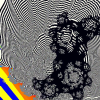
Manual controls have virtually no influence on the activity of the neural network, which here results in chaotic superimpositions of individual frames that also produce strongly iridescent effects. As the video progresses, the structures descend further into chaos, with manual controls offering no way to restore a stable state. Watching the video is an unpleasant experience.
On the Fly
:
(z3-z)/(cz2+1)
Boolean operation by XOR
ATTENTION: strongly iridescent
(0:37 min)
In this video, too, manual control loses its grip on the unfolding action. The neural network’s activity produces intensely iridescent effects, causing the structures to descend increasingly into chaos. Manual control succeeds only briefly in altering the structures before the neural network dissolves them once more. Watching the video is an unpleasant experience.
Clock Hand
:
(z3+c)/z
Combination by MAX-function
(1:01 min)
Once the video starts, the neural network overlays the input image with a multitude of circular forms resembling clocks. Manual controls trigger scaling and translational movements, causing the neural network to generate dynamic motion characterized by increasingly chaotic structures. However, manual control also allows for the creation of overlays in which the chaos is increasingly superimposed by planar structures.
Trinity in Red, Light, and Blue
:
(z3+c)/z
Boolean operation by AND
(1:30 min)
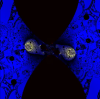
In the video, bluish areas and reddish "spheres"—manipulated via manual controls through scaling and translational movements—are swirled together and superimposed by the neural network, frequently creating three-dimensional impressions. The video's final sequence features extremely rapid image layering caused by a characteristic of the fractal wherein minute changes result in vastly different visual manifestations—changes that neither manual control nor the neural network can meaningfully influence. Yet, even amidst these rapid image sequences or abrupt transitions, a direct graphical connection exists between all the images, even if it is sometimes difficult to discern.
Insight Inhibited
:
(z3+c)/z
Boolean operation by OR NOT
ATTENTION: strongly iridescent
(0:56 min)
In this video, too, the neural network generates iridescent forms, but here the structures remain largely intact. However, manual control fails to return the system to the state it was in at the start of the recording, because the neural network's overlays have created new structures that can no longer be meaningfully influenced by manual control.
Yellow Rain
:
(z3+c)/z
Boolean operation by OR
(0:38 min)
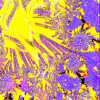
In this video, the neural network initially projects shapes resembling clocks. However, manual control during the recording causes the neural network to cover almost the entire image with a yellow hue in the final phase.
Red Christmas Bells
:
(z3+c)/z
Boolean operation by AND
(1:42 min)
Spherical forms are propelled through a space that occasionally appears three-dimensional—driven by a neural network—via manual controls that alter the coordinate system and position. By manually varying the parameter "c" as a function of time, the fractal function generates rapid image sequences featuring drastic changes in the fractal's appearance; ultimately, manual control makes it difficult to find a position that remains relatively stable. Once this position is reached, the video recording is stopped manually to avoid disrupting the largely monochromatic final image through further unpredictable effects from the neural network. The individual transitions within the video sequence—some of which are abrupt—build upon one another, even if the transitions do not always appear continuous.
Red Spheres
:
(z3+c)/z
Boolean operation by AND
(0:53 min)
Much like in the "Red Christmas Bells" video, spherical forms are pushed through space. This demonstrates how varying parameters and manual control inputs during recording generate different image sequences, even though the underlying fractal function remains the same.
Swirl
:
(z3-z)/(c*z2+1)
Boolean operation by AND
(1:33 min)
In this video, the fractal's mutable blue base structure remains visible for the most part. The neural network embeds this structure within chaotic vortex formations. After traveling through several vortices, the fractal itself is lost and has to be relocated via manual control during the recording. This manual manipulation also alters the fractal's base structure through the accumulation of substructures and curvatures. Finally, the neural network dissolves the base structure. To conclude, the parameters of the fractal function are modified again via manual control as the camera dives into a vortex, bringing the sequence to an end.